Quick Facts: Water Oak
Quercus nigra
50-80 ft
Fast
Full sun to partial shade
Moist, acidic, clay or sandy; tolerates poor drainage
USDA Zones 6b-9a
Water Oaks in the Atlanta Landscape
The Water Oak (Quercus nigra) is one of the most common trees you'll find across metro Atlanta. Fast growth and a willingness to put up with Atlanta's heavy clay soils made it a default planting choice for decades. But water oaks carry real drawbacks that every Atlanta homeowner should know about. These trees rocket to 50-80 feet yet are short-lived for an oak, typically hanging on only 60-80 years before decline sets in. Weak wood structure makes them especially prone to storm damage, a genuine hazard given Atlanta's frequent severe thunderstorms and occasional ice events.
Still, water oaks do throw substantial shade and are deeply threaded into Atlanta's urban canopy. Walk through Decatur, Kirkwood, East Lake, or Druid Hills and you'll see big water oaks forming canopy corridors along entire streets. Keeping these trees well-managed matters if you want them safe and standing as long as possible.
Identifying a Water Oak
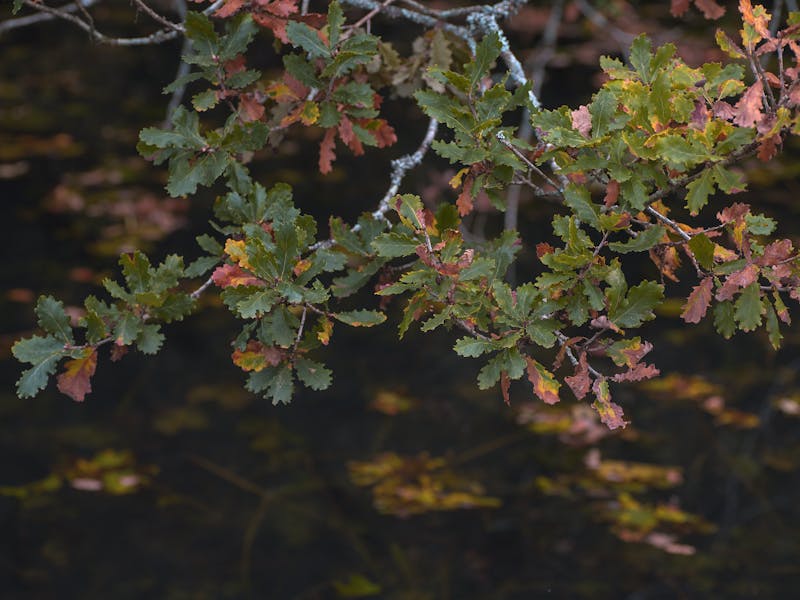
Water oaks are semi-evergreen around Atlanta, clinging to their leaves well into winter and finally dropping them in late January or February. Leaf shape varies a lot on this species, from spatula-shaped with a broad, rounded tip to slightly three-lobed. Most run 2 to 5 inches long, dull blue-green on top, slightly paler underneath. The variation trips people up, but the telltale spatula shape on mature branches is your best clue.
Bark starts smooth and dark gray on young trees, then darkens and picks up shallow furrows and scaly ridges with age. The acorns are small, about half an inch across, nearly round, and sit about one-quarter deep in a thin, saucer-shaped cap. Water oaks pump out acorns nearly every year. Messy cleanup comes with the territory.
The crown on a young water oak is rounded and dense, packed with ascending branches that build a full, symmetrical shape. That symmetry fades with age, particularly after storm hits or careless pruning.
Growing Conditions in Atlanta
Water oaks are extremely well-suited to Atlanta's growing conditions. They handle the heavy clay soils that frustrate many homeowners and tolerate both wet and moderately dry sites. Full sun is preferred, but partial shade works. Their knack for thriving in poor, soggy ground explains why you see so many of them along Atlanta's creeks and floodplains.
Here's the tradeoff: fast growth means weak wood. The rapid pace produces lower-density timber that snaps more easily. In Atlanta, where severe thunderstorms with straight-line winds roll through from spring to fall, that brittleness becomes a real liability.
Common Problems and Diseases
Root Rot hits water oaks hard, especially those planted in poorly drained corners of Atlanta yards. Phytophthora root rot and Armillaria (shoestring root rot) can eat away at the root system, turning an already structurally shaky tree into a genuine hazard. Warning signs: thinning canopy, yellowing foliage, and mushroom clusters sprouting near the base.
Weak Branch Unions are arguably the water oak's worst trait. These trees naturally form co-dominant stems and trap bark inside branch unions. Under rain-soaked foliage or a coat of ice, those flawed attachments split. Beginning structural pruning while the tree is young can cut this risk significantly.
Storm Damage is the number-one reason Atlanta homeowners call us about their water oaks. Brittle wood, poor branch attachments, and a tall, full canopy combine to make water oaks among the most failure-prone trees during storms. A proactive tree risk assessment can catch hazardous conditions before they lead to property damage or injury.
Care and Maintenance
Structural pruning is the single most important thing you can do for a water oak. Start young: remove co-dominant stems and branches with narrow, V-shaped unions. Lighten long horizontal limbs through crown reduction cuts. Mature water oaks should be inspected and pruned every 3 to 5 years by a qualified arborist to keep structural risks in check.
Go easy on fertilizer. Water oaks already grow fast enough in Atlanta's soils, and extra nitrogen just speeds up the production of brittle wood. If soil testing flags deficiencies, apply corrections as recommended.
Keep a close eye on trees over 50 years old. Thinning canopy, dead branch tips, and bark cracking can all point to internal decay. Aging water oaks grow increasingly hazardous and deserve regular monitoring.
When to Call an Arborist
Get in touch with an ISA-certified arborist right away if you spot large dead branches, splits in the trunk or major limbs, mushrooms growing at the base, or significant lean. After any major storm, have your water oaks professionally inspected. When a water oak is declining or has serious structural defects near a home or high-traffic area, professional tree removal may be the safest path forward. Our team at EastLake Tree provides honest assessments and can help you decide whether your water oak can be safely maintained or needs to come down.
Atlanta-Specific Tips
Water oaks in Atlanta benefit from hands-on management. Have young water oaks structurally pruned every 2 to 3 years to build a stronger framework. For mature trees, schedule an annual risk assessment before storm season kicks off in spring. Atlanta's clay soils hold moisture that can worsen root rot, so avoid overwatering and improve drainage where you can. If you need emergency tree service after a storm, EastLake Tree Services is available 24/7 to handle downed trees and hazardous limbs safely.