Quick Facts: Tulip Poplar
Liriodendron tulipifera
70-120 ft
Very fast
Full sun
Deep, moist, well-drained, slightly acidic
USDA Zones 4-9
The Tallest Eastern Hardwood
The Tulip Poplar (Liriodendron tulipifera), also called the tulip tree or yellow poplar, is the tallest native hardwood tree in eastern North America. In Atlanta's forests and older neighborhoods, mature tulip poplars rocket 70 to 120 feet above the ground, their straight, columnar trunks rising high before branching out. You'll find this tree all through metro Atlanta's canopy, especially in established neighborhoods with deep soils.
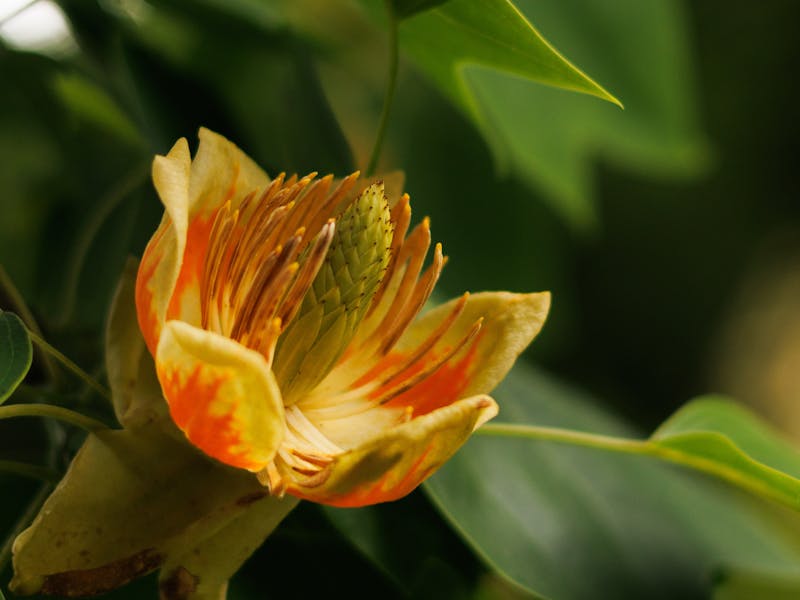
The name is misleading on two counts. The tulip poplar is neither a true poplar nor a tulip. It belongs to the magnolia family and produces distinctive tulip-shaped flowers in May and June. These greenish-yellow flowers with orange bases sit so high in the canopy that most people never notice them. The tree's rapid growth and sheer size make it both an asset and a real concern for Atlanta homeowners, depending on where it stands.
Identifying a Tulip Poplar
The leaf shape gives it away: four-lobed with a flat or slightly notched tip, resembling a cat's face or a tulip profile. Each leaf is 4 to 8 inches across, bright green above, and paler beneath. In a good autumn the foliage turns a clean golden yellow that lights up the whole yard. The bark on young trees is smooth and greenish-gray, becoming deeply furrowed with interlacing ridges on mature specimens, creating a distinctive diamond pattern.
The flowers appear in May-June at branch tips and are cup-shaped, about 2 inches across, with greenish-yellow petals marked by an orange band at the base. The fruit is a cone-shaped aggregate of winged seeds that hangs on the tree into winter.
Growing Conditions in Atlanta
Tulip poplars want deep, moist, well-drained, slightly acidic soils, and plenty of Atlanta properties sit on exactly that. They need full sun and ample space to reach their potential. Don't wedge one into a tight planting strip or a small yard. They do best with consistent moisture and struggle during prolonged drought.
In Atlanta's landscape, tulip poplars belong in large yards, parks, and naturalized areas where their size isn't a problem. Planting one near structures, power lines, or paved areas invites trouble down the road given their massive eventual size and habit of dropping hefty branches.
Common Problems and Diseases
Aphids and Sooty Mold draw more complaints than any other tulip poplar issue in Atlanta. Tulip tree aphids pile onto the leaves by the thousands during summer, dripping sticky honeydew onto everything beneath the tree. Black sooty mold fungus then colonizes the honeydew, coating cars, decks, patios, and outdoor furniture. The tree itself isn't seriously hurt, but the mess underneath drives homeowners up the wall.
Tulip Tree Scale is a large, conspicuous soft scale insect that latches onto branches and twigs. Heavy infestations cause branch dieback, more honeydew production, and overall decline. Professional treatment with systemic insecticides is the most reliable control.
Storm Damage keeps our crew at EastLake Tree busy after every big Atlanta thunderstorm. Tulip poplars stand tall and slender, catching wind like a sail, and their wood, while strong in compression, snaps rather than bends. Large limb failures are common during Atlanta's severe thunderstorms and ice events. A tree risk assessment can flag vulnerable limbs before the next storm rolls through.
Care and Maintenance
Mature tulip poplars don't ask for much beyond a watchful eye. Water during extended drought to head off premature leaf drop and reduce stress-related problems. Mulch broadly to hold soil moisture and protect surface roots.
Because of the tree's towering size, pruning usually comes down to removing dead branches and lightening end-weight on long, horizontal limbs. All pruning on large tulip poplars should be handled by qualified professionals with proper rigging and equipment. Period.
When to Call an Arborist
Call an ISA-certified arborist for annual inspections of large tulip poplars near structures, for stubborn aphid or scale problems, or after storm events. If a tulip poplar is declining or showing serious structural concerns, professional tree removal may be the safest path. These rank among the largest and most involved takedowns in the Atlanta area, requiring experienced crews and specialized equipment.
Atlanta-Specific Tips
Tulip poplars anchor Atlanta's natural forest canopy. If you have mature specimens on your property, fence them off during construction with proper tree protection zones. Park your car somewhere else from June through September unless you enjoy scrubbing aphid honeydew and sooty mold off the paint. We recommend having large tulip poplars inspected annually before storm season. If you're planting new trees, pick a spot with room to spare and reliable moisture. These trees need at least 30 feet of clearance from structures in all directions.